
Guide
How to descale a coffee maker (and keep it clean on Indian water)
Descaling means dissolving the chalky mineral deposit that hard water leaves inside a coffee maker’s boiler and pipes. On most Indian tap water you should do it every one to three months. The method is the same for nearly every electric machine: run a mild acid solution through, let it sit, then rinse with two or three tanks of clean water. The eight steps are below, with a care schedule for the weeks in between.
Check the manufacturer’s manual first: some machines have a descaling programme and some forbid vinegar. The Kafenio manuals are linked from the automatic machine and single-serve maker pages.
What scale is, and why Indian water makes it worse
Tap water carries dissolved calcium and magnesium. When a coffee maker heats it, some of those minerals come out of solution and stick to the hottest surfaces: the heating element, the boiler walls and the narrow pipes to the brew head. The deposit is limescale. It builds in thin layers, each one slowing the flow and insulating the element, so the machine works harder to reach the same temperature.
The Indian context matters: groundwater across much of the country is moderately to very hard, and borewell or tanker supply is often harder than municipal water. A machine that needs descaling twice a year in a soft-water city may need it monthly in a hard-water one. A simple check is your kettle: if it grows a white crust within weeks, your coffee maker is scaling at the same rate, out of sight.
Scale is not dirt and does not rinse out; it needs a mild acid, so descaling is a separate job from the weekly clean.
How often to descale
General guidance: every one to three months, towards monthly if your water is hard or the machine brews several cups a day, towards quarterly if you use filtered water or brew once a day. A machine with a scale indicator will tell you; otherwise set a reminder and watch for the signs below. For the Kafenio single-serve, the manual sets it at monthly, with 1 part vinegar to 3 parts water.
Between descales, the Kafenio FAQ gives the weekly routine for both machines: rinse the detachable parts with warm water, wipe the body, and run a water-only cycle once a week. That water cycle flushes loose residue before it hardens and is the single habit that stretches the gap between descales.
Filtered or RO water in the tank slows scaling considerably. Most manufacturers advise against fully demineralised water, as sensors and taste need some mineral content; check your manual.
Descale in 8 steps
General method for electric coffee makers using food-grade citric acid or a commercial descaler. Read your manual first; if it specifies a descaling programme or a particular product, follow that instead.
- Empty and rinse — Switch off and let the machine cool. Remove the drip tray, used grounds, any pod or filter, and the water tank. Rinse the tank with warm water.
- Mix the solution — A common ratio is 1–2 tablespoons of food-grade citric acid per litre of warm water, stirred until dissolved. For a commercial descaler, follow the label. Avoid vinegar unless your manual permits it; it lingers in seals and some manufacturers void the warranty for it.
- Fill the tank — Pour the solution into the tank and refit it. Place a large bowl under the outlet, and under the milk frother or steam wand if there is one.
- Run half a tank through — Start a brew cycle without coffee, or the descaling programme if the machine has one, and let about half the solution pass. Stop the machine.
- Let it sit — Leave the solution in the pipes and boiler for 15–30 minutes. This is where the acid works; running it straight through dissolves far less scale.
- Run the rest — Restart and let the remaining solution pass until the tank is empty. If there is a steam wand, draw some solution through it too.
- Rinse with clean water, twice or more — Rinse the tank, fill with fresh water and run the full tank through without coffee. Repeat; a third time if you can still smell the solution. Any acid left behind shows up in your next cup.
- Clean the parts and brew a test cup — Wash the drip tray, tank and detachable parts with warm water, wipe the body, reassemble and make a cup. Discard it. Note the date for the next descale.
Weekly, monthly, quarterly: a care schedule
A routine for an electric coffee maker on typical Indian water. The weekly row is the Kafenio FAQ routine; the rest is general guidance.
| How often | What to do | Why |
|---|---|---|
| After every use | Empty the drip tray and grounds; rinse milk parts at once | Milk residue sours within hours and blocks frothers |
| Weekly | Rinse detachable parts with warm water, wipe the body, run a water-only cycle | Flushes oils and loose residue before they set |
| Monthly | Wash the tank with mild soap; check the outlet for coffee build-up; descale if your water is hard | Tanks grow a film; hard water scales within weeks |
| Quarterly | Descale if not done monthly; check seals and the steam wand tip; clean any built-in grinder | Scale, worn seals and stale grounds cause most failures |
| Yearly | Re-read the manual's maintenance section; replace water filters if fitted | Filters and some seals have a service life |
The Kafenio single-serve manual says descale monthly with 1 part vinegar to 3 parts water; for the automatic, follow the manual linked from its product page. Both machines carry a 1-year warranty from the date of invoice.
Signs you need to descale
Scale builds up out of sight, so the machine tells you through symptoms. Any one of these means it is time; two together means it is overdue.
- Slow brewing. A cup that used to pour in 30 seconds takes a minute, or the flow thins to a dribble. Narrowed pipes are the cause.
- Coffee not hot enough. Scale on the element insulates it, so the water does not reach the same temperature. Lukewarm coffee from a machine that used to run hot is the classic sign.
- Louder than before. A pump straining against a blockage, or water boiling against a scaled element, makes more noise and a different noise.
- Chalky residue. White flakes in the tank, around the outlet or in the cup are scale that has broken loose.
- An off taste. Flat, metallic or faintly bitter coffee from a fresh pack points to the machine. Rule out stale coffee first: a 6 Degrees pack is best finished within three weeks of opening.
- A descale warning or the machine switching itself off, on models that have one.
Cleaning a single-serve hot and cold maker
A compact brewer like the Kafenio single-serve maker has fewer parts than an espresso machine, but it pours straight into the cup, so any residue goes into the cup too. The routine is short.
- After each use, empty and hand-wash the reusable mesh filter so grounds do not dry in place; the filter bracket can go on the top rack of a dishwasher.
- Weekly, follow the Kafenio FAQ: rinse the detachable parts with warm water, wipe the body, run a water-only cycle.
- After cold brewing, rinse the water path as you would after hot; cold water leaves less scale but the same coffee oils.
- Descale monthly, as the manual on the product page sets out: 1 part vinegar to 3 parts water, then rinse with clean water. With a small tank, one tank of solution and two rinse tanks usually finish the job.
- Leave the lid open and the tank empty if the machine will sit unused for a week or more.
Cleaning a coffee grinder
General guidance for anyone grinding at home. Coffee oils build up on burrs and in the chute, go rancid within a couple of weeks and taint every fresh dose.
- Weekly: unplug, brush out the burrs and chute with a dry, stiff brush, and wipe the hopper. Never use water on the burrs or motor.
- Monthly: run a grinder-cleaning product through and discard it. Some people use uncooked rice on burr grinders; check your manual, as some makers advise against it because of the load on the motor.
- When changing roasts: run a few grams of the new coffee through and discard it, especially going from a dark roast such as the Premium AAA to a lighter one.
If your machine has a built-in grinder, its manual says how to reach the burrs; do not improvise with tools.
Kafenio machines on this store
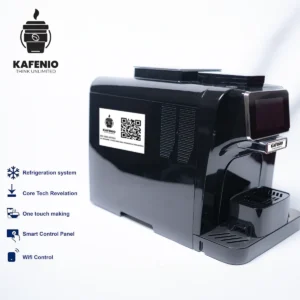
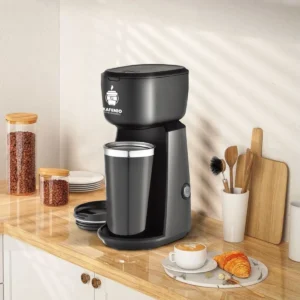
Both are described as easy to clean and maintain, with manuals and demonstration videos linked on their product pages.
-
Coffee Machines
Kafenio Noir Bean-to-Cup Coffee Machine
₹85,000.00Original price was: ₹85,000.00.₹65,000.00Current price is: ₹65,000.00. Add to cart Buy Now -
Coffee Machines
Kafenio Single-Serve Coffee Maker
₹3,500.00Original price was: ₹3,500.00.₹2,500.00Current price is: ₹2,500.00. Add to cart Buy Now
Frequently asked questions
Every one to three months as general guidance. Hard water (borewell, tanker, most groundwater) and several cups a day push it towards monthly; filtered water and one cup a day towards quarterly. Check your manual for the maker’s own interval.
Only if your manual allows it. Vinegar works but lingers in seals, and some manufacturers void the warranty for it. Food-grade citric acid at 1–2 tablespoons per litre, or a commercial descaler, is the safer general choice. The Kafenio single-serve manual does allow vinegar: 1 part to 3 parts water, monthly.
Follow the manual linked on each product page; it takes precedence over the general method here. For the single-serve that means monthly, with 1 part vinegar to 3 parts water. The weekly routine from the brand FAQ is to rinse the detachable parts with warm water, wipe the body and run a water-only cycle.
Descaling as described in the manual is normal maintenance; using a product the manual forbids may affect cover. Kafenio machines carry a 1-year warranty from the date of invoice; it excludes misuse and unauthorised repair, so follow the manual.
Usually not enough rinsing. Run one or two more full tanks of clean water through without coffee, then brew and discard a cup before drinking the next.